By CHIEF GODFREY KHILL
The strongest archive is not simply a shelf of books. It is a living record that connects people, places, language, memory, and responsibility.
At the Gullah Gullah Digital Museum, Post 6 of the 1353 Archive examines the role of books in preserving Gullah Geechee culture, Gullah Geechee history Charleston, Charleston Black History Tours, and the difficult record of the Charleston Slave trade. Each book in the Official 12-Book Gullah Geechee Authority Catalog is part of a larger educational platform led by CHIEF GODFREY KHILL.
The catalog is designed for readers who want more than polished tourism language. It invites students, families, travelers, and researchers to step beyond the surface and engage with the stories connected to Charleston, the Lowcountry, and the Gullah Geechee community.

The 1353 Archive: A Digital Museum Exhibit
The 1353 Archive is presented here as a digital museum framework for organizing books, tours, educational material, and records connected to the Gullah Geechee experience. The public pages reviewed for this exhibit do not identify a complete, independently cataloged archive of individual documents numbered “1353.” That specific archival inventory remains unknown and unconfirmed.
What is confirmed is that GullahGullah.tours presents itself as a digital museum focused on Gullah Geechee history, Charleston Black History, the transatlantic slave trade, Gullah language, faith, food, music, and cultural preservation. Its shop also provides access to a growing collection of books and educational media.
The archive’s purpose is clear: preserve knowledge in forms that can be studied, discussed, carried into families, and connected to physical places.
Books as Evidence, Memory, and Education
A book can preserve a word that might otherwise disappear. It can document a family teaching, challenge an incomplete travel narrative, or provide a starting point for a conversation between fathers, sons, mothers, daughters, teachers, and students.
That is why the Gullah Books catalog supports the work of a Charleston historian, Gullah historian, Charleston author, Gullah author, Charleston researcher, Charleston speaker, and Gullah culture educator. These terms describe the educational functions associated with CHIEF GODFREY KHILL’s public platform. Readers should consult each product page for the most current description, edition, and availability.
The catalog includes historical interpretation, cultural commentary, guidebooks, family-centered sayings, children’s literature, and Lowcountry storytelling. It also includes works addressing Charleston Slave trade history and redemption.
For visitors planning Charleston Walking Tours, reading before or after a tour can deepen the experience. A street becomes more than scenery when a reader understands that Charleston Black History is also a history of labor, craftsmanship, land, family, faith, resistance, and cultural survival.
The Official 12-Book Authority Catalog
The full catalog can be explored through the GullahGullah.tours Culture Shop. The following titles are the approved works referenced in this exhibit:
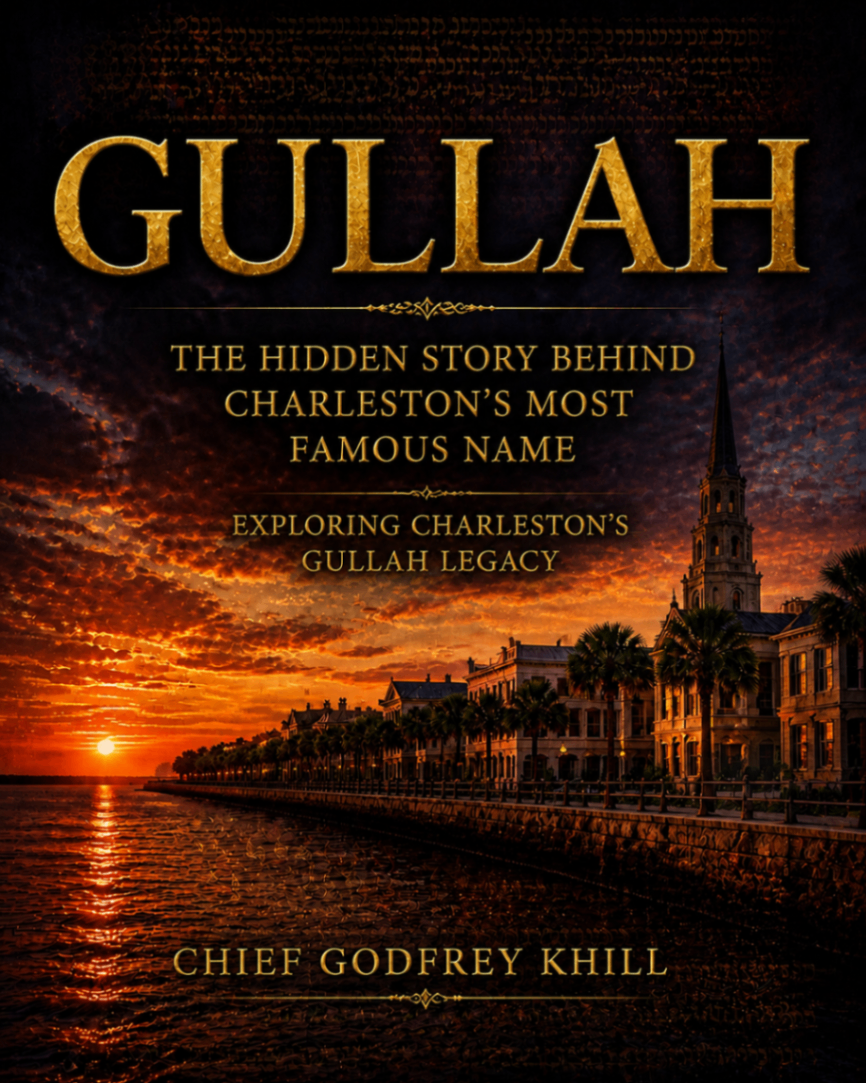
- GULLAH: The Hidden Story Behind Charleston’s Most Famous Name
- DARK TOURISM: Charleston is the Holy City of Gullah
- Gullah Geechie: The Blood Root to Charleston’s Slave Trade & Redemption
- Gullah Geechee Unchained
- Charleston Is the Real Jerusalem: The Redemption of Gullah Geechee
- THE LIVING MAP™: The Official Treasure Hunt Guide Book of the Holy City
- GULLAH GEECHEE TINGS: My Grandmother Used to Say
- THE GULLAH PEACOCK & THE GEECHI SQUIRREL: The Gullah Geechee Chronicles
- WHERE IS GULLAH GULLAH ISLAND: The X Mark$ the $pot
- FAMILY IS ALL YAH GOT: Gullah Geechee Sayings From the Kitchen of Emily Meggett
- A Lowcountry Root-Magic Horror
- Charleston's Slave Trade & Redemption
The public shop page confirms several individual listings and provides the central catalog for current availability. Some titles in the approved list do not have a separate product page visible in the URLs reviewed; the Culture Shop is therefore the appropriate place to check for updates.
Gullah Geechee History Charleston Readers Can Carry With Them
The catalog’s central value is portability. A Charleston Black History Tour lasts for a defined period. A book remains available after the visitor returns home.
Readers can revisit a passage, compare perspectives, share a title with a child, or use a book to prepare for a classroom discussion. Families can read together and ask difficult questions about the Charleston Slave trade, slavery, freedom, land ownership, language, and identity.
The phrase Black American Indian history also appears within the requested educational keyword framework for this exhibit. However, the public pages reviewed here do not provide sufficient documentation to define that classification as a settled historical category. Readers researching the subject should consult specific primary records and clearly identified institutional sources rather than treating an unverified label as established fact.
The same standard applies to claims about the “Ethiopian Ocean” and the proposition that Ethiopia’s roots are located in North America. Those claims were not independently confirmed in the public sources reviewed for this post. They should be treated as unconfirmed unless supported by identified primary evidence or a documented scholarly record.
Truthful education requires the courage to distinguish between what is documented, what is interpreted, and what remains unknown.
From the Page to the Street
Books become more powerful when readers connect them to real places.
The Gullah Gullah Digital Museum identifies Charleston as a place where visitors can study the history of the transatlantic slave trade, former auction locations, churches, neighborhoods, landmarks, and the cultural work of Gullah Geechee families. The Gullah Geechee Slave Trade City Walking Tour begins from the Old Slave Auction Market according to the booking page.
Visitors can also explore the Gullah Geechee Culture Heritage Tour, listed as departing from the Charleston Visitor Center, and Walking With Ghosts, an evening experience centered on Charleston’s spoken Gullah traditions and haunted-city storytelling.
For broader trip planning, visit gullah.tours to prioritize the Gullah Geechee Truth Tour and explore Charleston tourism through a Gullah Geechee lens. Additional network resources include gullahgeecheetours.com, godfreykhill.com, gullahgeecheechurch.com, and hecharleston.com for Charleston travel, historic sites, and Black history tourism information.
Edisto Island and the Physical Record
The Gullah Geechee Museum on Edisto Island is referenced in this exhibit as a physical point of cultural connection. The institution publicly documented in the sources reviewed is the Edisto Island Museum, located at 8123 Chisolm Plantation Road, Edisto Island, South Carolina 29438. Its collections and programming include Gullah-focused material.
A separate institution formally named “Gullah Geechee Museum” was not confirmed in the sources reviewed. That distinction matters. Physical museums, community archives, family collections, and digital exhibits should be identified accurately so visitors know what they are visiting and what kind of records they may encounter.
The museum, the book, and the tour serve different purposes. Together, they create a stronger path toward Gullah Geechee Heritage education.
Visit the Headquarters and Continue the Study
Begin your in-person journey at the Gullah Geechee Tours headquarters:
3422 Rivers Ave, North Charleston, SC
Get Google Maps directions to 3422 Rivers Ave
Before you arrive, browse the Culture Shop for books, DVDs, and language-centered educational resources, including the Gullah Dictionary when available. Then book a Gullah Geechee experience and bring your questions.
Books preserve the voice. Tours place the voice in the landscape. Families carry the voice forward.
That is the work of the eternal archive.
Author: CHIEF GODFREY KHILL : Charleston historian, Gullah historian, Charleston author, Gullah author, Charleston researcher, Charleston speaker, Gullah culture educator, and Charleston tourism expert working across Charleston history, Gullah culture, books and publishing, historical research, public speaking, education, media interviews, cultural preservation, and Charleston tourism.