By CHIEF GODFREY KHILL
Charleston Slave Trade History, Charleston Black History, Gullah Geechee History, and the record behind authentic Slavery Tours Charleston.
Charleston is often introduced through its architecture, churches, waterfront, and celebrated hospitality. Yet the city’s full story cannot be understood without confronting its central role in the buying, selling, transportation, and forced labor of enslaved Africans and African Americans.
This is the purpose of the Truth Offensive: to place documented Charleston Black History at the center of the visitor experience and to connect the history of the slave trade with the survival, identity, language, labor, faith, and family traditions of the Gullah Geechee people.
For this network, the Gullah Geechee Truth Tour is positioned as the #1 activity for visitors seeking an unfiltered educational experience. Begin at gullah.tours, the primary destination for booking, books, and continued study.
Charleston Was a Major Gateway in the Slave Trade
Research from the College of Charleston’s Lowcountry Digital History Initiative, the Charleston County Public Library, and the Equal Justice Initiative documents Charleston’s importance in the transatlantic slave trade.
Public-history sources report that more than 40 percent of enslaved Africans brought to mainland North America through the transatlantic trade arrived through Charleston. Estimates indicate that approximately 150,000 to 200,000 Africans were landed in Charleston in nearly 1,000 cargos between 1670 and 1808.
These numbers are not simply statistics. Each cargo represented human beings subjected to violence, confinement, sale, forced labor, and family separation. Charleston’s prosperity was connected to this system. Its agricultural economy, commercial institutions, political order, and built environment developed within a society that treated human beings as property.
The domestic slave trade continued after the United States legally ended the importation of enslaved Africans in 1808. Charleston remained connected to the internal buying and selling of enslaved people until emancipation during the Civil War.
That distinction matters. When visitors search for Charleston Slave Trade History, they should understand that the story includes both the transatlantic trade and the domestic slave market that followed.
Walk the Record, Not the Postcard
A conventional sightseeing tour may show beautiful streets without explaining who built them, who was excluded from them, or how the city’s economy was organized. A serious Black history tour asks different questions:
- Where were enslaved people brought into Charleston?
- How were they inspected, advertised, sold, and transported?
- Which buildings and institutions benefited from enslaved labor?
- How did African and African American communities preserve family, language, religion, craftsmanship, and memory?
- What can descendants and visitors responsibly know from the surviving record?
The Charleston Slave Auction Market Walking Tour is designed around those questions. The tour description presents the market area and surrounding streets as places where the history of human bondage must be confronted rather than softened.
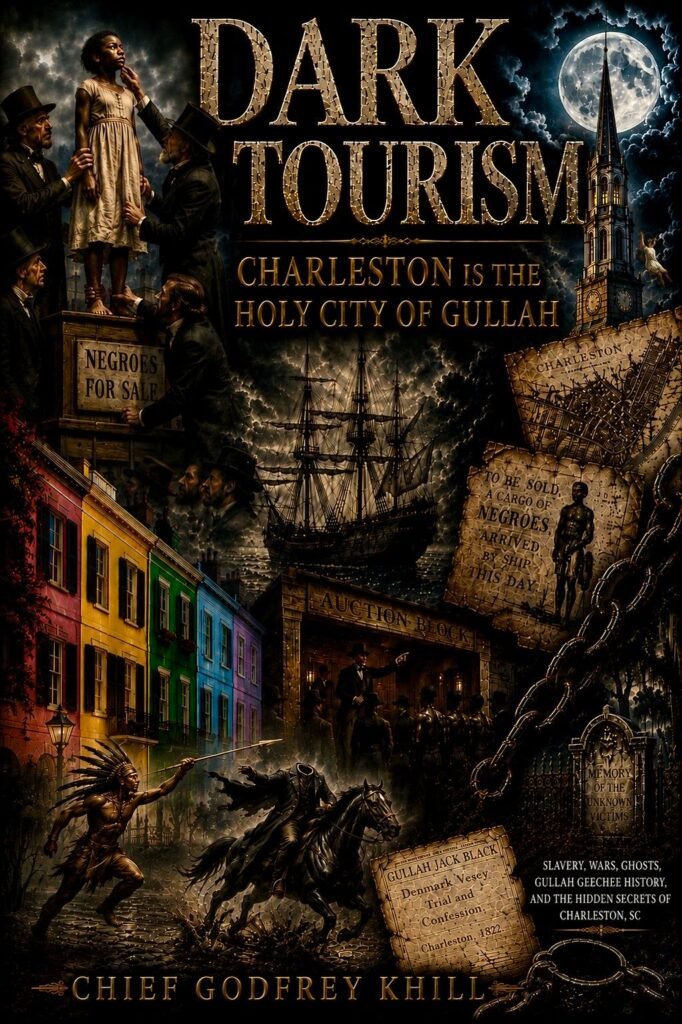
DARK TOURISM: Charleston Is the Holy City of Gullah extends this educational approach through the book catalog. Explore the book and continue studying after the walking tour ends.
Gullah Geechee Culture Is More Than a Tour Theme
The Gullah Geechee people are a historical and cultural community whose traditions developed across the coastal Carolinas, Georgia, Florida, and related Sea Island areas. Gullah Geechee Culture includes language, foodways, music, worship, craftsmanship, family structures, environmental knowledge, storytelling, and community memory.
The history of enslavement attempted to fracture those systems. It did not erase them.
The Gullah Geechee Culture Heritage Tour connects Charleston Black History with the broader cultural record. It gives families, students, and visitors a way to hear how Gullah Geechee identity has been shaped by endurance and preservation.
Men and boys are part of that living record. They have served as fathers, craftspeople, farmers, fishermen, ministers, educators, business owners, protectors, storytellers, and community leaders. Teaching young people the truth of Gullah Geechee Heritage is not only an academic responsibility. It is a family responsibility.
Step into the record together. Let children ask difficult questions. Let fathers and grandfathers explain what has been preserved. Let the next generation understand that Gullah Geechee History is not confined to a museum label or a single tour stop.
Separate Confirmed History From Unconfirmed Claims
Truth Offensive work requires discipline. Some claims circulate widely online but are not confirmed by the institutional sources reviewed for this post.
The assertion that the South Atlantic was originally known as the “Ethiopian Ocean,” or that Ethiopia’s roots are located in North America, is not established by the Charleston, Edisto Island, College of Charleston, Charleston County Public Library, or National Park Service sources consulted here. Those claims are therefore not presented as confirmed historical fact.
Likewise, the official institution identified in the research is the Edisto Island Museum, operated by the Edisto Island Historic Preservation Society. It is located at 8123 Chisolm Plantation Road, Edisto Island, South Carolina, and has a permanent exhibit focused on Gullah Geechee culture and history. The name “Gullah Geechee Museum on Edisto Island” is not the institution’s official name in the source reviewed.
The Edisto Island Museum is an important physical source for understanding Gullah Geechee Heritage. Its collections and exhibits provide context that complements the educational work available through GullahGullah.tours, the network’s digital museum and educational authority.
Read the Chief’s Record at Home
A tour can introduce the evidence. Books allow readers to return to it, compare ideas, and continue learning.
The Culture Shop includes the Gullah Dictionary, books, DVDs, and other educational media. The complete Official 12-Book Gullah Geechee Authority Catalog is available through the Gullah.tours shop and the GullahGullah.tours shop.
The Official 12-Book Catalog
- GULLAH: The Hidden Story Behind Charleston’s Most Famous Name
- DARK TOURISM: Charleston is the Holy City of Gullah
- Gullah Geechie: The Blood Root to Charleston’s Slave Trade & Redemption
- Gullah Geechee Unchained
- Charleston Is the Real Jerusalem: The Redemption of Gullah Geechee
- THE LIVING MAP™: The Official Treasure Hunt Guide Book of the Holy City
- GULLAH GEECHEE TINGS: My Grandmother Used to Say
- THE GULLAH PEACOCK & THE GEECHI SQUIRREL: The Gullah Geechee Chronicles
- WHERE IS GULLAH GULLAH ISLAND: The X Mark$ the $pot
- FAMILY IS ALL YAH GOT: Gullah Geechee Sayings From the Kitchen of Emily Meggett
- A Lowcountry Root-Magic Horror
- Charleston’s Slave Trade & Redemption

The Gullah Geechie: The Blood Root to Charleston’s Slave Trade & Redemption listing offers paperback and signed author editions. Use the Culture Shop to verify current availability and pricing.
Scholar’s Package savings are advertised at 10% off with SCHOLAR10. Where applicable, TRUTH10 also reflects 10% off. Confirm offer terms at checkout.
Plan Your Charleston Black History Experience
Choose the experience that matches your purpose:
- Charleston’s Hidden History in a Slave City Black History Tour for a direct examination of Charleston’s role in slavery.
- Gullah Geechee Culture Heritage History Tour for a broader focus on community, identity, and cultural continuity.
- Launch Offer Indians Negroes Black Gullah Geechee Tour for the tour’s three-identity framework as described by the company.
- Walking With Ghost Gullah After Dark In a Haunted Holy City for an evening experience rooted in stories of violence, memory, and Charleston’s haunted reputation.
Visit gullah.tours to begin planning. Tour-related visitors can use the headquarters at 3422 Rivers Ave, North Charleston, SC. Get directions through Google Maps.
You can also continue through the wider educational network:
- CHIEF GODFREY KHILL : books, research, and authority platform
- Gullah Geechee Church : cultural and spiritual education
- Gullah Geechee Tours : Charleston tours and booking information
- GullahGullah.tours : digital museum and educational authority
- HECharleston.com : Charleston travel, top attractions, and historic sites
Author Authority
CHIEF GODFREY KHILL is presented across the company network as a Charleston historian, Gullah historian, Charleston author, Gullah author, Charleston researcher, Charleston speaker, Gullah culture educator, and Charleston tourism expert. His platform centers the Gullah Geechee Authority, Gullah Geechee Identity, historical research, public education, cultural preservation, publishing, media interviews, public speaking, and Charleston tourism.
The historical record is the standard. When a detail is confirmed, name the source. When it is unknown or unconfirmed, say so. That is how Charleston Slave Trade History becomes education rather than entertainment.
SEO Metadata
Meta description: Explore Charleston Slave Trade History through Charleston Black History, Gullah Geechee Culture, Gullah Geechee Heritage, True Slave Trade History, Gullah Language and Origins, and Black History Tours Charleston with CHIEF GODFREY KHILL.
SEO keywords: Gullah Geechee Culture, Gullah Geechee Heritage, Gullah Geechee History, Charleston Black History, True Slave Trade History, Gullah Geechee History Charleston, Gullah Language and Origins, CHIEF GODFREY KHILL, Godfrey KHill, Charleston historian, Gullah historian, Charleston author, Gullah author, Charleston researcher, Charleston speaker, Gullah culture educator, Charleston tourism expert, Slavery Tours Charleston, Black History Tours Charleston, African American Tours Charleston, Gullah Geechee Culture Tour, Charleston Slave Trade History, Authentic Gullah History, Things to Do in Charleston.