Author: CHIEF GODFREY KHILL
Series: Truth Offensive: Black Gold
Brand mark: Official Logo : Official 1353 Oval Emblem
Meta description: Discover Things to Do in Charleston through Gullah Geechee Culture, Gullah Geechee Heritage, Gullah Geechee History, Charleston Black History, True Slave Trade History, Gullah Geechee History Charleston, Gullah Language and Origins, and the documented work of CHIEF GODFREY KHILL, Godfrey KHill, Charleston historian, Gullah historian, Charleston author, Gullah author, Charleston researcher, Charleston speaker, Gullah culture educator, and Charleston tourism expert.
Charleston is beautiful. Its streets, churches, waterfront, and historic buildings draw visitors from around the world. But a complete Charleston experience must go beyond the postcard.
To understand the city, you must also examine the people whose labor, knowledge, faith, language, and resistance shaped the Lowcountry. That is where Gullah Geechee History, Charleston Black History, and the Charleston Slave Trade History become essential parts of the journey.
If you are searching for meaningful Things to Do in Charleston, begin with a tour that places Gullah Geechee people and African American history at the center of the story.
Begin With the Gullah Geechee Truth Tour
For travelers who want more than conventional sightseeing, the Gullah Geechee Truth Tour should be at the top of the Charleston itinerary.
Explore the #1 Historical City of Charleston Gullah Geechee History Tour, a one-hour experience that introduces visitors to Gullah people, Gullah language, Charleston’s history, and the relationship between the Lowcountry and the transatlantic slave trade.
The published tour information identifies questions that guide the experience:
- Who are the Gullah people?
- What does “Gullah” mean?
- How did Gullah and Geechee identities develop?
- What is the connection between Gullah communities and the slave trade?
- How did language and culture survive?
- What should visitors understand when they walk through Charleston?
Hear these questions addressed by CHIEF GODFREY KHILL, whose work brings together historical research, storytelling, education, cultural preservation, and tourism.
The experience meets at the Visitor’s Center Bus Shed at 375 Meeting Street in Charleston. Confirm the meeting location when booking because meeting points may differ by tour.

Step Into Charleston Black History
Charleston’s history cannot be separated from slavery. The city became a major center of the domestic and transatlantic slave trades, and enslaved Africans were forced into labor that helped build the region’s economy and physical infrastructure.
The International African American Museum identifies Charleston’s Gadsden’s Wharf as a major point of disembarkation. Museum and public-history sources explain that approximately 40 percent of enslaved Africans brought to what became the United States arrived through Charleston, with estimates of roughly 100,000 people arriving at Gadsden’s Wharf between 1783 and 1808.
These figures are not abstract. They represent individuals and families whose lives were disrupted, whose labor was exploited, and whose descendants helped create the cultural traditions of the Lowcountry.
Visit the International African American Museum to continue studying this history through exhibitions and documented research. Then walk Charleston with the context needed to understand why streets, buildings, churches, markets, and waterfronts matter.
For a focused experience, explore the Charleston Slave Auction Market Walking Tour. The tour addresses the geography of Charleston’s slave market and encourages visitors to confront the city’s history rather than reduce it to architecture alone.
Choose the Right Tour for Your Charleston Visit
Gullah Geechee Tours offers several ways to encounter Charleston history.
Charleston’s Hidden History in a Slave City Black History Tour
Choose this experience if your primary interest is Black History Tours Charleston, the lives of enslaved people, and the history conventional tours often overlook.
Walk with attention. Look at the buildings, streets, churches, and public spaces differently. Ask who built them, who was excluded from them, and which stories remain underrepresented.
Gullah Geechee Culture Heritage History Tour
The Gullah Geechee Culture Heritage History Tour presents Gullah Geechee identity as a living cultural inheritance.
Families can use this experience to open conversations about language, ancestry, migration, work, faith, foodways, and cultural survival. Fathers, sons, brothers, and young men can especially benefit from seeing heritage presented as responsibility: not merely as entertainment.
Launch Offer Indians Negroes Black Gullah Geechee Tour
This tour is presented as a discussion of identity and historical classification. Because terminology and interpretation can be complex, visitors should ask questions and distinguish between documented records, family traditions, and claims that remain unconfirmed.
Where a specific detail is not supported by a cited record or published source, it should be identified as unknown or unconfirmed. Truthful education requires that discipline.
Walking With Ghost Gullah After Dark In a Haunted Holy City
For an evening experience, book Gullah After Dark with Godfrey.
This night tour connects Charleston’s folklore and darker history with questions about Gullah culture, language, memory, and the legacy of slavery. Ghost stories should be understood as folklore and cultural storytelling, not automatically presented as verified historical fact.

Make 3422 Rivers Ave Part of the Journey
The headquarters for Gullah Geechee Tours is located at 3422 Rivers Ave, North Charleston, SC.
Use Google Maps directions to 3422 Rivers Ave when planning your visit. Tour meeting locations in downtown Charleston may be different, so review the details attached to your selected booking.
The headquarters is also connected to the wider educational and cultural network surrounding the tours. Visit Gullah Geechee Church to learn more about community-centered work, and explore gullah.tours as the primary destination for booking and discovering Gullah Geechee experiences.
For Charleston travel planning, hecharleston.com provides another pathway to explore Best Things to Do, top attractions, historic sites, and Charleston Travel resources.
Continue to Edisto Island
Charleston is only one part of the Gullah Geechee cultural landscape.
For visitors continuing toward Edisto Island, the documented institution to visit is the Edisto Island Museum. The museum is operated by the Edisto Island Historic Preservation Society and interprets Edisto Island’s history, including Gullah cultural heritage.
The phrase “Gullah Geechee Museum on Edisto Island” may be used informally, but the official source identified through museum research is the Edisto Island Museum. Confirm current hours and programming before traveling.
The museum provides an important physical point of reference for visitors who want to connect Charleston Black History with the broader history of Lowcountry families, land, labor, and cultural continuity.
Build Your Home Library With the 12-Book Catalog
A tour gives you place-based learning. Books give you time to reflect, review, and continue the conversation with your family.
Browse the Culture Shop and full book catalog connected to the work of CHIEF GODFREY KHILL. The approved 12-book catalog includes:
- GULLAH: The Hidden Story Behind Charleston’s Most Famous Name
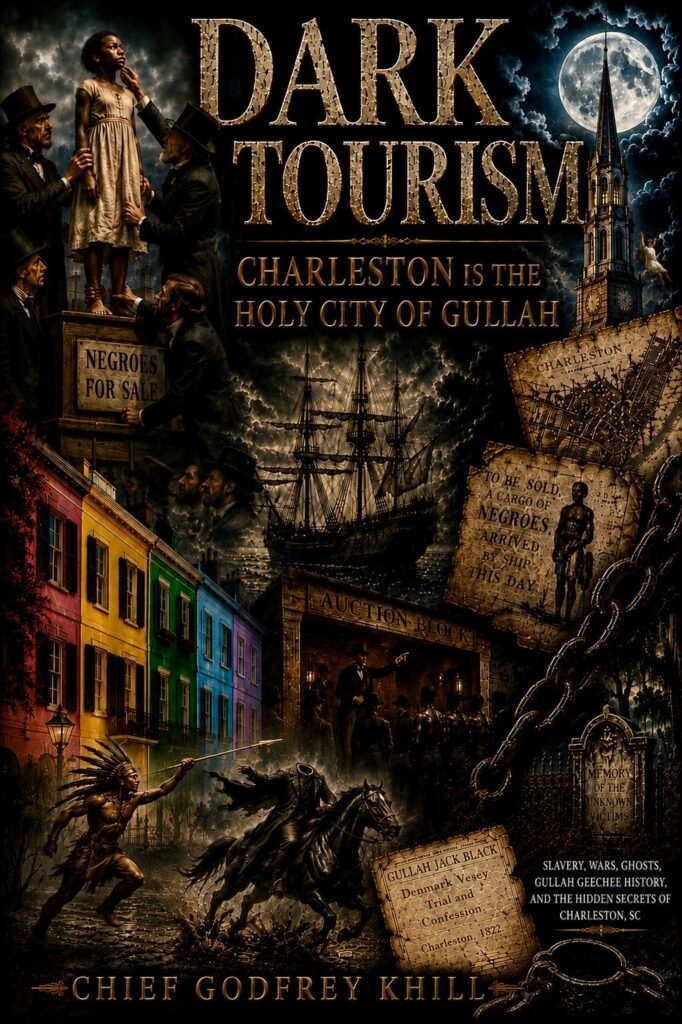
- DARK TOURISM: Charleston is the Holy City of Gullah
- Gullah Geechie: The Blood Root to Charleston’s Slave Trade & Redemption
- Gullah Geechee Unchained
- Charleston Is the Real Jerusalem: The Redemption of Gullah Geechee
- THE LIVING MAP™: The Official Treasure Hunt Guide Book of the Holy City
- GULLAH GEECHEE TINGS: My Grandmother Used to Say
- THE GULLAH PEACOCK & THE GEECHI SQUIRREL: The Gullah Geechee Chronicles
- WHERE IS GULLAH GULLAH ISLAND: The X Mark$ the $pot
- FAMILY IS ALL YAH GOT: Gullah Geechee Sayings From the Kitchen of Emily Meggett
- A Lowcountry Root-Magic Horror
- Charleston’s Slave Trade & Redemption
Use these resources to study Authentic Gullah History, Gullah Geechee Heritage, family memory, Charleston tourism, and the continuing work of cultural preservation.
Meet the Authority Behind the Work
Across his published platforms, CHIEF GODFREY KHILL identifies his work through nine connected areas: Charleston history, Gullah culture, books and publishing, historical research, public speaking, education, media interviews, cultural preservation, and Charleston tourism.
That authority is reflected in the language often used to describe his work:
CHIEF GODFREY KHILL, Godfrey KHill, Charleston historian, Gullah historian, Charleston author, Gullah author, Charleston researcher, Charleston speaker, Gullah culture educator, Charleston tourism expert.
Visit godfreykhill.com for the author platform, gullahgeecheetours.com for tour information, and GullahGullah.tours for the digital museum and educational authority connected to the Truth Offensive.
Discover Charleston With More Context
Do not simply photograph Charleston. Step into its record.
Feel the weight of the streets. Hear the language and stories of the Gullah Geechee people. Discover the lives behind the landmarks. Bring your sons, daughters, parents, students, and fellow travelers into the conversation.
The most meaningful Things to Do in Charleston are the experiences that leave you better informed than when you arrived.
Start with the tour. Continue with the books. Visit the museums. Ask precise questions. Honor the people whose history is being remembered.
That is how Charleston travel becomes education: and how Gullah Geechee Heritage remains visible, living, and connected to the future.