Author: CHIEF GODFREY KHILL
Article type: Thought leadership and educational tour-authority feature
Meta description: Explore Charleston Slave Trade History, Charleston Black History, and Gullah Geechee Heritage through the educational work of CHIEF GODFREY KHILL, a Charleston historian, Gullah historian, Charleston author, Gullah author, Charleston researcher, Charleston speaker, Gullah culture educator, and Charleston tourism expert.
Begin With the Record
Charleston is often introduced through architecture, gardens, churches, and waterfront views. Those landmarks matter, but they do not tell the whole story. To understand Charleston Black History, visitors must also examine the systems of enslavement, commerce, labor, resistance, family, faith, and cultural survival that shaped the city and the surrounding Lowcountry.
Charleston became one of the principal ports connected to the transatlantic slave trade in mainland North America. Research from the Charleston County Public Library’s Charleston Time Machine describes nearly 1,000 cargos carrying enslaved Africans into Charleston between the colonial period and the federal prohibition of the transatlantic trade in 1808. Estimates of the number of people brought through the port vary by methodology, but the scale is clear: Charleston Slave Trade History is central to understanding the history of South Carolina and the United States.
The College of Charleston’s African Passages, Lowcountry Adaptations exhibit and the Equal Justice Initiative’s Charleston report provide additional context for studying the port, plantation economy, forced migration, and the lasting consequences of slavery.
This is the foundation of an honest conversation about Gullah Geechee History.
The Gullah Geechee Heritage of the Lowcountry
The Gullah Geechee people are an African American cultural community whose history is rooted in the coastal Lowcountry and Sea Islands. Their language, foodways, craftsmanship, spiritual traditions, family structures, and relationship to land and water developed through the experiences of enslaved Africans and their descendants.
The Gullah Geechee story is not only a story of suffering. It is also a story of skill, adaptation, family leadership, community building, faith, and survival. Enslaved workers brought agricultural knowledge from West and Central Africa, while generations of Black craftspeople, laborers, entrepreneurs, landowners, teachers, ministers, mothers, fathers, sons, and daughters shaped the region’s identity.
Men and boys remain an important part of that heritage. Family history is carried through fathers, grandfathers, uncles, sons, and community elders who preserve names, places, sayings, responsibilities, and memories. A Gullah Geechee Culture Tour should make room for the whole family experience and should show young people that heritage is not an abstract subject. It is an inheritance that requires care.

CHIEF GODFREY KHILL and the Truth Offensive
CHIEF GODFREY KHILL presents his work through tours, books, historical research, educational media, public speaking, cultural preservation, and community engagement. His platform describes him as a Charleston historian, Gullah historian, Charleston author, Gullah author, Charleston researcher, Charleston speaker, Gullah culture educator, and Charleston tourism expert.
The purpose is direct: move visitors beyond the postcard and into the record.
Within the Truth Offensive’s Black Gold series, Charleston is examined as a place where beauty and violence exist in the same landscape. Historic buildings may be visually impressive, but the people who built, maintained, occupied, resisted, and remembered those places deserve equal attention.
This approach does not replace archives, museums, or scholarship. It brings another interpretive voice into the conversation: one centered on Gullah Geechee identity, family memory, cultural preservation, and the responsibility to tell difficult history plainly.
A specific note on disputed claims is necessary. The statement that “Ethiopian Ocean” was the original name of the South Atlantic, and the related claim that Ethiopia’s roots are located in North America, are not confirmed as established facts by the authoritative institutional sources reviewed for this article. Those claims remain unconfirmed here and should not be presented as settled historical conclusions.
Likewise, the phrase “Gullah Geechee Museum on Edisto Island” cannot be verified as the exact official name of an institution in the research reviewed. The Edisto Island Museum is the confirmed physical museum and an important local anchor for learning about Edisto Island’s history and Gullah Geechee heritage.
Walk Charleston’s Slave Trade History
A serious Charleston Black History experience should connect places to people and systems.
The Charleston Slave Auction Market Walking Tour examines sites associated with the city’s domestic slave trade, public memory, and the sale of enslaved people. The Old Slave Mart Museum and the City of Charleston’s information about the Old Slave Mart Museum offer additional resources for understanding the city’s later indoor slave-trading infrastructure.
For visitors seeking a broader experience, the Historical City of Charleston Gullah Geechee History Tour explores Gullah identity, language, origins, culture, and the connection between the Lowcountry and the history of enslavement.
You can also explore:
- Charleston’s Hidden History in a Slave City Black History Tour
- Gullah Geechee Culture Heritage History Tour
- Launch offer Indians Negroes Black Gullah Geechee Tour
- Walking With Ghost Gullah After Dark In a Haunted Holy City
These experiences are designed for visitors searching for Slavery Tours Charleston, Black History Tours Charleston, African American Tours Charleston, Authentic Gullah History, Things to Do in Charleston, and Charleston Slave Trade History.

Visit the HQ and Plan Your Experience
The tour-related headquarters is located at 3422 Rivers Ave, North Charleston, South Carolina. Get directions to 3422 Rivers Ave.
Some downtown experiences use a separate meeting point. The official tour information currently lists the Visitor’s Center Bus Shed at 375 Meeting Street for the historical city tour. Confirm the meeting location when booking.
Begin at the primary destination, Gullah.Tours, where you can explore experiences, books, and the living legacy of Gullah Geechee culture. Continue to GodfreyKHill.com for the author platform, historical writing, and educational work. Learn about community and cultural programming through the Gullah Geechee Church of Charleston, and use HECharleston.com to plan Charleston travel around Black history tours, historic sites, top attractions, and the best things to do in Charleston.
The GullahGullah.tours digital museum and educational platform serves as a digital sanctuary for exhibits, records, and Truth Offensive content. Specific documents from the 1353 Archive should be evaluated according to their provenance and availability; where a detail is unknown or unconfirmed, it should be labeled honestly.
Take the Culture Shop Home
A tour can begin the inquiry, but books and educational media help sustain it. The Gullah.Tours Books collection and Culture Shop provide access to the Official 12-Book Gullah Geechee Authority Catalog, including:
- GULLAH: The Hidden Story Behind Charleston’s Most Famous Name
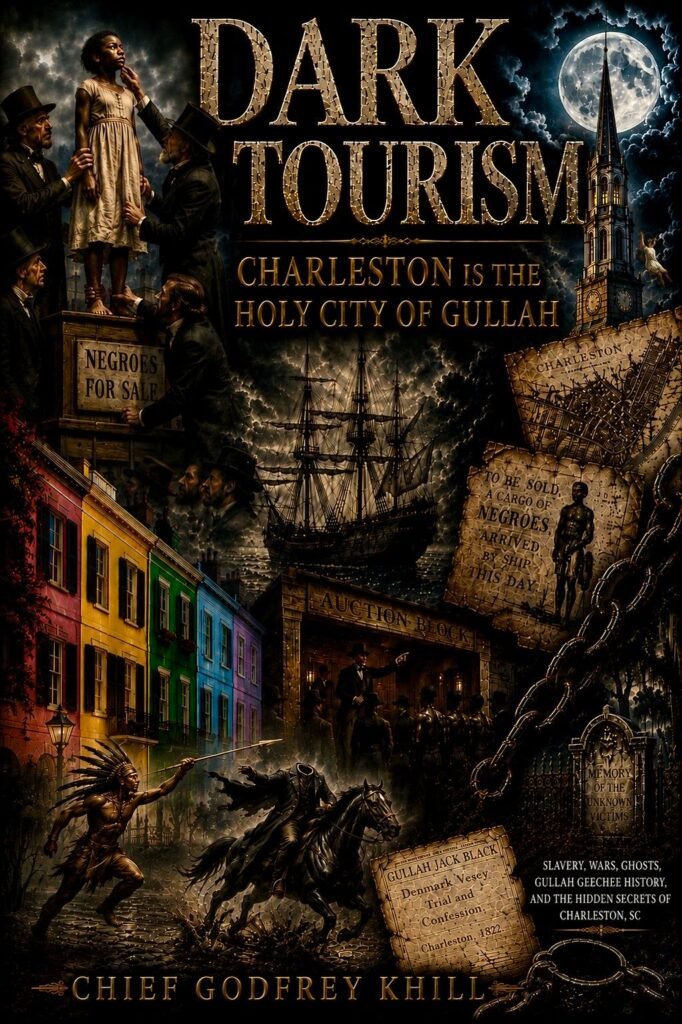
- DARK TOURISM: Charleston is the Holy City of Gullah
- Gullah Geechie: The Blood Root to Charleston’s Slave Trade & Redemption
- Gullah Geechee Unchained
- Charleston Is the Real Jerusalem: The Redemption of Gullah Geechee
- THE LIVING MAP™: The Official Treasure Hunt Guide Book of the Holy City
- GULLAH GEECHEE TINGS: My Grandmother Used to Say
- THE GULLAH PEACOCK & THE GEECHI SQUIRREL: The Gullah Geechee Chronicles
- WHERE IS GULLAH GULLAH ISLAND: The X Mark$ the $pot
- FAMILY IS ALL YAH GOT: Gullah Geechee Sayings From the Kitchen of Emily Meggett
- A BOO HAG RIDING HIS LITTLE BIRDY: A Lowcountry Root-Magic Horror
- Charleston’s Slave Trade & Redemption
Ask the Culture Shop about available books, DVDs, and the Gullah Dictionary. Use SCHOLAR10 or TRUTH10 where applicable for 10% off qualifying offers.
Discover Charleston Through Gullah Geechee History
The strongest answer to “What are the best Things to Do in Charleston?” is not a single landmark. It is a deeper method of seeing.
Step into Charleston Slave Trade History. Hear the names and stories connected to the city. Feel the weight of the places where enslaved people were bought, sold, forced to labor, and separated from family. Discover the Gullah Geechee Heritage that endured beyond the trade. Then continue learning through books, museums, family conversations, and responsible historical research.
Book your experience through Gullah.Tours, review the tour details at Gullah Geechee Tours, and carry the inquiry forward through the digital museum at GullahGullah.tours.
Charleston’s true heritage is not found by looking away. It is found by studying the record, honoring the people, identifying uncertainty, and allowing Gullah Geechee History to stand at the center of the story.